This week, Congress finally passed a budget agreement that ended the longest U.S. government shutdown in history after 43 days. The S&P 500 is up around 1% during that stretch and yields haven’t moved much. If you only looked at the weekly chart you would think nothing happened. But underneath the surface we saw daily 1–2% swings that have become far too common.
Even though prices have been bouncing around, the underlying market has actually been very stable. The stocks that were up the most this year simply went through a correction, while most higher quality names didn’t move much at all.
The Narrative Shift in AI
What triggered the AI correction was a single post. Michael Burry, who became famous after calling the 2008 housing collapse, wrote that tech companies are boosting near-term profits by extending the useful life of their AI equipment. He called it one of the more common frauds of the modern era.
His argument is that companies are depreciating AI servers over 5–6 years when he believes the real useful life is closer to 2–3. Stretching an expense over a longer period makes short-term profits look higher. In his view, some of these companies are overstating earnings by more than 20%. In reality they are following the tax code, and the truth is probably somewhere in between. But markets move on narrative, not accounting nuance, and his post was enough to spark selling across the AI sector. A few stocks were trading at extreme valuations and were due to correct no matter what the catalyst was.
What made Burry’s post even more confusing was that he also sent a letter to his clients saying he is liquidating his funds and returning capital because his view of value hasn’t lined up with the market for some time. This is a good reminder of how sentiment shifts today. One influential voice can move stocks as much as an economic release. I expect these AI stocks to continue swinging 3–5% per week.
Buffett’s Silence and a Major Move
On the opposite side, Warren Buffett wrote in his most recent letter that he is going quiet because he knows anything he says can move markets. He has spent the last few years pointing out that stock compensation is a real expense and that many companies understate it. That argument is far stronger and more important than the depreciation debate. Still, the depreciation story caught fire this week and triggered a short-term sell-off.
As for markets, Buffett did say that because of current valuations, ideas are few but not zero. After the close, the Berkshire Hathaway quarterly 13F was released and the most interesting takeaway was a new position in Google. It was about a $4B purchase. Buffett has talked for years about how he wished he bought Google earlier because he saw how much his own companies were spending on ads with them. It’s not clear whether he made the buy himself or whether it came from one of his investment managers, especially given he said he is still showing up to work but not active day-to-day. If it wasn’t him, it could signal a shift inside Berkshire that they are more willing to buy growth stocks again.
The Monopoly Moat
This leads into something I have talked about with many clients. The best investment ideas over the last decade have overwhelmingly been growth companies, and many of them have become monopolies. I am almost certain whoever bought Google at Berkshire made the purchase after Google won its monopoly case last quarter. That ruling removed the biggest overhang, which was a potential breakup. Even though they won, I still believe Google is a monopoly, and clearly so do the people inside Berkshire. You could say the same thing about Amazon. If the valuation were right it would probably be a large holding there too. Apple, Microsoft, Meta, and Netflix all fit the same profile. They aren’t replaceable. They beat the competition, acquire them when needed, and defend their turf better than anyone.
This could be happening again if Netflix buys Warner Brothers next week. All these companies know that AI or quantum computing is the biggest threat to their dominance, which is exactly why they are spending the most money on it. If it works, great. If it doesn’t, it likely means it didn’t work for anyone else either, which keeps their monopolies intact. You could see write-downs of AI chips in years 4–6 if Burry is right, but the market would probably flip the narrative, absorb the hit in one quarter, and move on. These are the companies you buy on dips because they generate the most cash, carry the least debt, and can innovate into products that don’t exist yet.
Portfolio Strategy: Growth vs. Value Traps
This is why large cap tech will continue to lead. The best investment is finding a monopoly before it becomes one. That is why Tesla trades at such a rich valuation. It could have a monopoly on autonomous vehicles and robotics. The competition in EVs is too tough, especially from China, so that monopoly probably never happens.
The alternative to growth is dividend-paying stocks. They don’t move much, but many clients rely on the income. The best investment is a growth monopoly that also pays a large dividend. A decade ago you could find those. Today most tech companies prefer buybacks. The third category, and the most dangerous, is the undervalued company that is losing to the monopolies. Investors figured this out and mostly stopped buying them. That is why many of these stocks remain cheap even with 3% yields and buybacks. They simply have no revenue growth.
The best diversification today is an overweight to monopolies, a selective bet on a few possible future monopolies, and a mix of dividend stocks instead of loading up on bonds. Holding some treasuries as a parking spot for the next big opportunity is fine. But the value traps in category three are best avoided unless the math makes absolutely no sense. They are also the hardest to hold in a downturn.
Economic Realities and The Fed
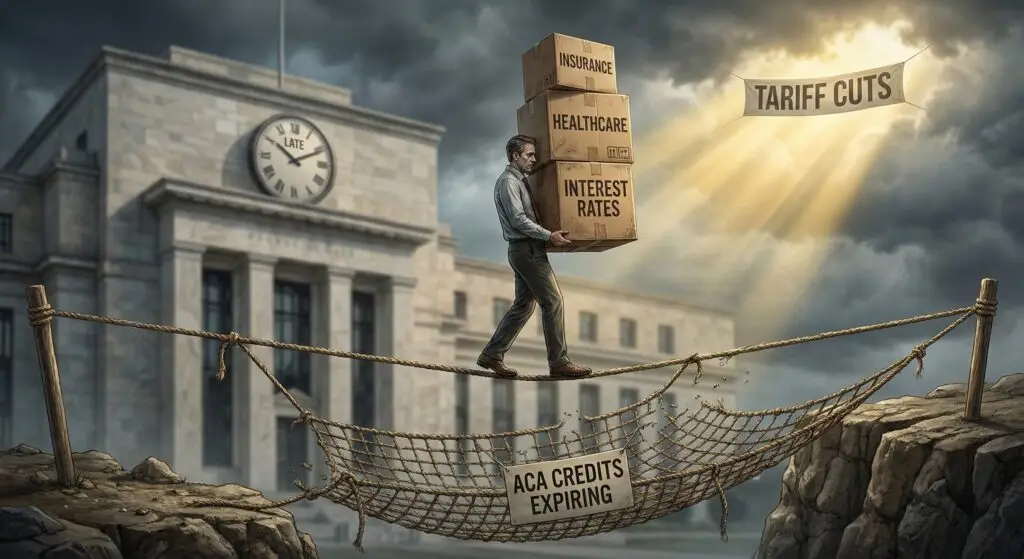
Looking ahead, with the shutdown over, government agencies will finally start releasing all the delayed economic reports. Markets will react to them even though they get revised every month. The Fed remains the biggest factor. In my view they are behind. Rates should already be 1% lower, but instead they remain focused on optics and politics. Bond yields have actually risen since the last Fed meeting. Meanwhile the real economy is sending mixed signals. A client with deep real estate experience told me this week that parts of Florida have completely stalled. He put an offer $100k under asking on a $350k house and got it. Insurance costs are now directly impacting prices. If you have cash and are willing to take on the risk, there are more deals emerging in different parts of the country.
Looming Pressures: Healthcare and Tariffs
Another pressure point that could hit households next year and strain the real estate market further is health care costs. The Affordable Care Act enhanced premium tax credits are scheduled to expire at the end of 2025. These temporary tax credits capped benchmark premiums at 8.5% of income, even for higher-income households, and removed the old subsidy cliff. When these expire, the subsidy cliff comes back. Anyone under age 65 who buys health insurance on the ACA marketplace and earns above 400% of the Federal Poverty Level — roughly $128,600 for a family of four — will lose 100% of their subsidy and pay the full premium. For older clients and larger families this can mean premium increases of tens of thousands of dollars. That level of financial shock will force many households to drop coverage entirely, creating a major gap in financial security and putting more pressure on strained budgets.
There is also growing stress on the middle class, and consumer sentiment readings have dropped to new lows. President Trump issued an Executive Order yesterday rolling back tariffs on a wide range of imported food items and commodities because the cost of groceries has become too much. Many economists have said for years that tariffs were being passed directly to consumers. The rollback is meant to give people fast relief. The question is why it took so long for the administration to acknowledge that tariffs are a tax on the consumer. With midterms approaching and polling shifting, that realization finally set in. The bigger question is whether companies will lower their prices after using tariffs as an excuse to raise them. This may explain why earnings have held up so well even though the economy hasn’t grown much.
All of this makes the Fed’s job even more important. If rates drop and momentum improves, the market should stabilize. If the Fed keeps waiting and focuses too much on headline inflation instead of what is happening to the middle class, volatility will continue. Their disconnect is as frustrating as the trade war was. In my opinion Trump is right to question why the Fed isn’t cutting rates. Households need relief from high mortgage rates, credit card rates, and financing costs. High rates do not fight inflation at this point. They are simply another tax on the consumer, just like the tariffs. Unfortunately politics seems to have taken over the Fed. If they don’t change course, I expect a bumpy market led by tech with consumer stocks the most vulnerable.
Have a great weekend!
Sources
- Congressional Budget Agreement & Government Shutdown Data
- S&P 500 Market Performance Data
- Michael Burry Client Letter & Social Media Commentary
- Warren Buffett Shareholder Letter
- Berkshire Hathaway 13F Filing
- Google Antitrust Ruling
- Affordable Care Act (ACA) Tax Credit Provisions
- Federal Poverty Level Guidelines
- Executive Order on Tariff Rollbacks
Disclaimer
The information provided in this communication is for informational purposes only and does not constitute financial, investment, or legal advice. All content is based on data and sources believed to be reliable, but accuracy and completeness cannot be guaranteed. Market conditions and economic factors are subject to rapid change. Past performance is not indicative of future results. The views expressed herein are those of the author and do not necessarily reflect the official policy or position of any other agency, organization, employer, or company. Investors should conduct their own research and consult with a qualified financial advisor before making any investment decisions. The author may hold positions in securities mentioned in this post.