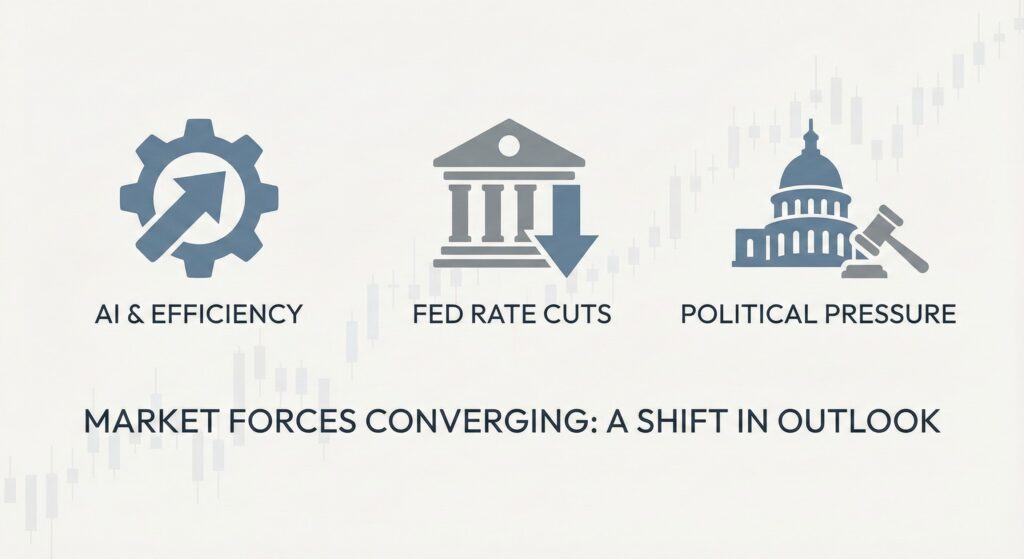
This week, markets fell steadily until Powell’s remarks in Jackson Hole yesterday shifted expectations for a rate cut. He acknowledged that downside risks to employment are rising and suggested that Trump’s tariffs are likely to only have a short-lived impact on inflation. Powell reminded markets that policy is still in restrictive territory, but with the balance of risks shifting, an adjustment in stance could be warranted. If there’s one lesson that always comes back in markets, it’s not to fight the Fed. A shift in policy direction, even a subtle one, has sweeping implications for rates, corporate profits, and investor sentiment.
Politics Meets Policy
At the same time, politics are colliding with monetary policy in ways we haven’t seen in decades. President Trump has intensified efforts to gain influence over the Fed, recently targeting Governor Lisa Cook after accusations raised by Bill Pulte at the Federal Housing Finance Agency. Cook has said she has no plans to step down, but the possibility of being removed “for cause” remains. This is less about one individual and more about a broader strategy. Trump wants people in place who align with his views, and if he gains another seat, he could shape a majority on the Fed’s Board of Governors. Markets are watching closely because personnel shifts at the Fed ultimately shape policy outcomes.
The AI Factor and Employment
Trump’s second term has already shown that he is following through on what he said he would do, and for markets that matters. If he backs up his words, interest rates are coming down and not just gradually. They could collapse quickly, opening the door to another refinancing boom. The question is whether the Fed’s concern about the job market is less about cyclical weakness and more about structural change, particularly companies choosing not to hire because AI tools now let them do more with fewer workers.
If that is the case, we may only be at the beginning of this trend. AI is inherently deflationary. it reduces costs and strips away wage bargaining power. The only workers likely to retain leverage are those with direct AI skills or expertise in managing these tools. That creates the possibility of entire industries being reshaped, with some sectors hollowed out while others expand. The full impact on employment is unknown. Some economists argue the fears are overstated, but even MIT research has pointed out that most organizations so far have earned little to no measurable return on AI investments. That suggests we are still in the early innings of adoption. The effect may be uneven, and while not every company will gain efficiency, enough of them will to keep pressure on hiring.
Cracks in the Labor Market
For younger workers, the cracks are already showing. Entry-level opportunities are shrinking, and the unemployment rate for recent college graduates has climbed close to 5.5%, around double the national average. Business owners are leaning on existing staff and layering in AI tools rather than taking on new hires. This helps profits by cutting labor costs, but it creates a tougher path for new entrants into the workforce. For markets, it means corporate margins may improve even if the labor market softens, a dynamic that works against inflationary pressure.
The Inflation Backdrop
That backdrop makes the case for lower rates even stronger. Housing prices have flattened year over year, and inventory is much higher. Flat housing prices are not inflationary, and with energy prices sitting in the low $60s, there are few signs of inflation anywhere else. If employment weakens further while inflation stays quiet, the Fed has cover to move quickly on rate cuts. Add Trump’s pressure for lower rates, and the odds rise that easing could come faster than investors currently expect.
Market Outlook
The good news continues to be that corporate earnings remain solid, and consumers are still spending, though more selectively. But markets are running into the reality of full valuations. Multiples are stretched, leaving less room for error. Future market gains depend on earnings growth and relief from interest rates. That equation changes dramatically if rates fall. Lower yields make dividend-paying stocks more attractive and tend to lift small-cap shares, which historically do well in falling rate environments. If the next rounds of job and inflation data confirm more weakness without rising prices, investors will begin to reprice for a lower-rate environment.
A Fed preparing to ease, a White House eager to see rates fall, structural shifts in the labor market, and corporate profits supported by AI-driven cost cuts all converge into a market that could look very different in the months ahead. The risk remains that valuations are stretched, and political influence on the Fed could push investors into unfamiliar territory. Powell’s comments yesterday were an inflection point for bonds, and the direction of interest rates will likely determine the path forward for everything else.
Have a great weekend!
Sources
1. Jerome Powell’s remarks in Jackson Hole regarding employment risks and policy stance.
2. Political developments involving President Trump, Governor Lisa Cook, and Bill Pulte at the Federal Housing Finance Agency.
3. Unemployment rate for recent college graduates (approx. 5.5%).
4. MIT research on organizational returns on AI investments.
5. Housing market data: flattened year-over-year prices and higher inventory.
6. Energy market data: prices in the low $60s.
Disclaimer
“The information provided in this communication is for informational purposes only and does not constitute financial, investment, or legal advice. All content is based on data and sources believed to be reliable, but accuracy and completeness cannot be guaranteed. Market conditions and economic factors are subject to rapid change. Past performance is not indicative of future results. The views expressed herein are those of the author and do not necessarily reflect the official policy or position of any other agency, organization, employer, or company. Investors should conduct their own research and consult with a qualified financial advisor before making any investment decisions. The author may hold positions in securities mentioned in this post.”